A frozen world. A boy with a reed flute called the Nay. A journey east, against the clock, to remember how spring begins.
The story
The opening of the first chapter
Hawraman has forgotten what spring sounds like. For most of its people, winter has always been the world. Only a few grandmothers remember the warmth, and most have learned not to ask why. When his twin sister falls to the cold-in-the-blood, the shepherd Yima follows a stray sheep into a hidden cave, plants a seed his grandmother has been keeping for generations, and discovers a reed that sings like the world used to. The cure draws soldiers. The music draws something colder. And before the Bull constellation sets on the equinox, Yima, his sister, his friends, and a creature who refuses to stay small must walk seven trials and learn the seven wisdoms that keep a world from freezing over.
Chapter 1: The Illness
The Fever
My sister was dying, and I was standing there with another wet cloth in my hands.
The water was cold, everything in Hawraman was cold, but Yameh's forehead burned like she'd swallowed sunlight and it was burning inside her. If the sun still existed. I pressed the cloth against her skin and watched the fabric steam.
"Yima." Her voice came out thin and cracked, like ice over a stream. "Stop hovering."
"I'm not hovering. I'm holding a cloth to your head. There's a difference."
"You're hovering with a cloth."
She coughed, a small wet sound, and then, without opening her eyes: "Tell Grandma not to put the garlic in the broth. She'll try. It tastes like an old boot."
"She says it helps."
"It helps her. Not the same thing." Her hand twitched toward the edge of the bed, fingers feeling along the seam. "And my rock. The flat one. You moved it."
I hadn't. But I reached under the blanket, and there it was, small, grey, a pale vein running through it like a crack of lightning, exactly where she'd said. I pressed it into her palm. Her fingers closed around it, and she sighed, satisfied, like I'd finally gotten one thing right all day.
She was right about the hovering. I wasn't about to admit it. Yameh had always been the twin who finished my sentences and stole my better ideas and made them sound wiser in her mouth. She was the strong one, the clever one. Seeing her pale and shaking under three layers of sheepskin felt wrong, her dark hair plastered to her face with sweat.
I wrung out the cloth again. My hands wouldn't stop shaking, and not from the cold.
Our father had stumbled through the door that morning looking like something the mountain had crushed and thrown aside. Blood streaked his tunic, dark and drying in places, fresh in others. A ragged wound split his forehead, still weeping at the edges, and his boots left red-brown prints on the stone floor. He smelled of snow and iron.
"A raid," he'd said, collapsing onto our wooden stool, which groaned under his weight, as if even the stool objected. He rubbed his face with both hands, exhaustion carved into every line. "Beasts in the mountain pass. We lost men. Barely made it back."
Grandma had rushed to him, her fingers going straight to his pulse before her knees were even down. I'd never seen Grandma afraid before, but she couldn't keep the fear out of her eyes.
"Just need sleep," he'd mumbled.
We all knew sleep wouldn't fix whatever had broken up there in the mountains.
And then, that same night, Yameh's cough had started.
It began as nothing, a tickle in the throat, a rasp, a cough that seems easy to ignore. By midnight she was burning. By dawn she couldn't sit up. The fever came so fast it felt as if something inside her had struck flint and sparked a fire, which was a terrifying thought in a world where fire was forbidden.
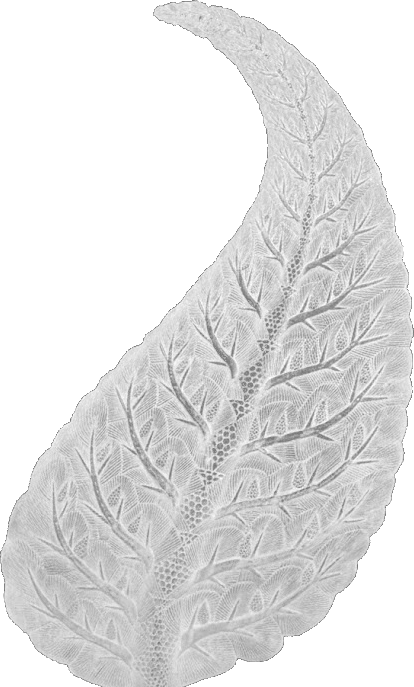
I pulled the Boteh from my pocket, the small teardrop-shaped tapestry my mother had woven before we were born. Its tree-of-life pattern was almost worn smooth now, the wool soft as felt from years of nervous handling. The whole shape tilted like it was leaning into an invisible wind, its branches reaching out like arms. My mother had woven two of them, one for me and one for Yameh, the nights before giving birth to us. She'd been a wind-listener, Grandma said, someone who could hear what the breeze carried from impossibly far away. All I'd inherited was that I clutched the Boteh whenever I had nothing else to do with my hands.
Right now, I didn't know what else to do with anything.
I caught myself humming, low and tuneless. Mom's habit, Grandma had said once; wind-listeners hum to hear themselves think over the wind. I didn't remember Mom. I remembered the humming.
Yameh's chest rose and fell in shallow, stuttering breaths. Each exhale rattled like stones in a jar. I started counting them because counting gave me something to hold onto. Twenty-three. Twenty-four. A pause that lasted too long, and then twenty-five.
I let out my own breath.
Outside, the wind howled across the valley like an angry div, one of those shadow-beasts from Grandma's stories. The sky was its usual grey, the same flat grey it had been every day of my fifteen years, and every day of Grandma's, and every day her grandmother had ever spoken of. You'd think the world could invent a new colour after all this time. Snow buried everything. Ice gripped the rocks and trees, and even the air felt frozen in place. Our settlement, Hawraman, huddled against the mountainside, cave-houses carved into the stone, connected by narrow paths that the wind turned into howling funnels every night.
And now whatever that cold was, it was inside my sister's blood, and I was sitting here with a damp cloth like that meant anything.
The Healer's Verdict
Hustana arrived when the light shifted from dark grey to slightly less dark grey. Morning, probably, though it was hard to tell when the sky never changed.
She was a tall, weathered woman with calloused hands and a leather satchel that smelled of dried thyme and something sharper. Part healer, part tracker, part the woman who made you feel like complaining was a weakness of character. She could set a broken bone and close a wound, and she knew twenty plants in a snowfield by sight. Half the settlement owed her their lives.
She knelt beside Yameh without a word, pressing her palm to my sister's forehead, then her neck, then pulling back an eyelid to look at something I couldn't see. Her expression didn't change. Hustana never let you read her face when she was working.
"How long?" she asked.
"Since last night. It started as a cough and then," I gestured helplessly at my twin sister, so fiercely ill she barely seemed like herself.
"The cold is in her blood." Hustana said it to Grandma, not to me. Grandma stood in the doorway with her arms crossed tight across her chest, her face mapped with worry lines I'd never noticed before. "This isn't ordinary winter-sickness. It's deeper. The frost is eating inward."
"Can you---"
"I can make her comfortable." Hustana's voice was flat and honest and terrible. "I can slow it. But I don't have anything that cures cold at the bone. No one does. Not anymore."
She mixed something from her satchel, herbs and crushed bark and a dark paste, and applied it to Yameh's chest. The smell was bitter and green.
"Keep her warm," Hustana said, standing and wiping her hands on her wrap. "Keep the cloths damp. If the fever breaks on its own, she might fight it off."
"And if it doesn't?"
She looked at me. I wished she hadn't.
"Then you pray to whatever you believe in, boy."
She didn't wait for a response. She was already at the door, satchel in hand. "There are others. The sickness is spreading. Pirouz's children. Old Khosrow. Little Atosa." She paused. "Azhi's sister, Parisa, is the worst after yours. Same fever that won't break."
Her mouth thinned. The herbs weren't going to be enough.
After she left, Grandma picked up the mortar and started grinding the herbs Hustana had mixed. The sound of stone on stone filled the room. Nobody said anything for a while.
I sat there feeling useless. My twin was sick and I was fine. We'd shared everything since before we were born, and now her body was at war with winter and mine was just sitting there, wringing out cloths.
Grandma lowered herself onto the stool by Yameh's bed, her knees creaking like old wood. She took my sister's hand, so small and fever-slick in her weathered grip, and began to murmur something I didn't recognise, something old. A prayer, maybe, or a lullaby from a time so distant it had lost its language and kept only its rhythm.
"...the dance that was broken," she whispered, her thumb tracing circles on Yameh's palm. "...the flame that went cold... Yamshid the shining, who held the long dark back, before the long dark held us..."
I waited for more. An explanation. A story. Grandma always had a story for everything, the ice on the peaks, the patterns in the stars, why certain sheep were born stubborn and certain boys were born impatient.
But she just kept murmuring, her eyes closed, her lips barely moving, and whatever she was saying slipped back into silence.
The Crooked Horn
I lasted about an hour before I couldn't sit useless anymore. Watching Yameh's chest rise and fall, counting breaths, waiting for Hustana's herbs to do something or nothing. I'm not made for waiting. Yameh would say it's my worst quality, right after my tendency to trip over flat ground and my habit of arguing with sheep.
"I'm going to check on the flock," I told Grandma.
She looked at me over Yameh's sleeping form, her eyes soft with a knowing I didn't want to look at too closely. "The flock is fine."
"Someone needs to---"
"Yima." Her voice was gentle but firm. "Go. Walk. Clear your head. You're no good to her sitting here biting your nails raw."
So I went.
The cold hit the moment I stepped outside, bitter and personal, finding every gap in my wrapping. I pulled my sheepskin tighter and headed for the upper pasture where we kept the flock during storms.
The paths between the cave-houses were nearly empty. A few figures moved in the distance, hunched against the wind. Thin smoke, the barely-there kind that Hawraman allowed, curled from a few doorways. From behind closed doors I heard coughing. Lots of coughing.
The sheep were fine. Of course they were. Twenty-seven woolly bodies huddled together as one, steam rising from their shared warmth. I counted them twice, because the first time I got twenty-six.
I counted again. Twenty-six.
The troublemaker, the one with the crooked horn that bent sideways like an afterthought, the one who'd been making my life difficult since she was a lamb with a bad attitude, was gone. She'd slipped past the marker twice this season already, drawn up the ridge by something I couldn't smell. Both times I'd caught her before the boulder field and dragged her back cursing. This time she'd gone further. Because of course she had. My sister was dying, my father was wounded, half the town was sick, and this particular sheep had chosen today to wander toward the mountain pass.
"You woolly menace," I muttered, and started climbing.
The tracks weren't hard to follow. Crooked-horn left a distinctive trail, one hoof slightly turned and dragging, like she walked with an opinion about the direction the world was headed. The prints led up the narrow path toward the ridgeline, past the frozen stream, past the stone marker where the Wind-Listeners left their offerings to whatever they thought was listening back.
I almost turned around three times. My fingers were going numb. The wind was worse up here, cutting through my wrap like it wasn't there. But every time I thought about going back, back to the hut, back to that bed, back to the sound of my sister's breathing getting worse, my feet kept moving. If I sat down again without being able to do something, I'd crack apart.
That's when I felt it.
Warmth.
It wasn't much, just a trace of it in the bitter air. I stopped, confused, and turned my face into the wind. There, from somewhere up ahead past the boulder field, flowing out of the mountainside itself, a warm draft that pressed against my frozen cheeks like breath.
I followed it. The warmth grew stronger as I climbed, pulling me along a path I couldn't see but could feel.
The crooked-horn sheep stood at the mouth of a crack in the mountainside, chewing contentedly on something green. Actual green, growing from the rock, in a world that hadn't seen that colour in living memory. Moss, pale and soft, lining a warm damp gap in the stone.
"How did you---" I started, but the sheep just looked at me with that blank, self-satisfied expression sheep get when they've been smarter than you and know it.
I squeezed past her and into the crack. The passage was tight, my shoulders brushing both walls, curving deeper into the mountain and angling down. The air grew warmer with every step. The sound of my footsteps changed from sharp clicks on ice to muffled thuds on something softer. Ahead, a faint glow, and a low hum from the walls themselves, deep and resonant, like the mountain was singing through its hollow places.
The Impossible Cave
The walls were covered in stones that glowed.
Not firelight, nothing that crude or familiar. I didn't know the names of those colors---deep blues, dark reds, all of them strangely alive. And the light was warm. Against my frozen fingers, the heat coming off those stones felt like the most sacred thing in the world.
Crystal-clear pools dotted the smooth floor, each one catching the glow and throwing it back in rippling patterns across the ceiling. Water trickled down the walls in thin streams, gathering in basins carved by centuries of steady flow. The air smelled of wet stone and something sweeter, like the herbs Grandma hung in her doorway during the trade season.
I pressed my back against the wall and slid down until I was sitting on the warm floor. For a long moment I just breathed. Warm air in my lungs instead of ice. My jaw unclenched. I hadn't realised how tight I'd been holding everything since Yameh started coughing.
Then I looked up, and I saw the drawings.
They covered every surface, painted on the stone in pigments that still held their colour after what must have been centuries, maybe longer. The images were dense, layered, telling a story I couldn't read but couldn't stop staring at.
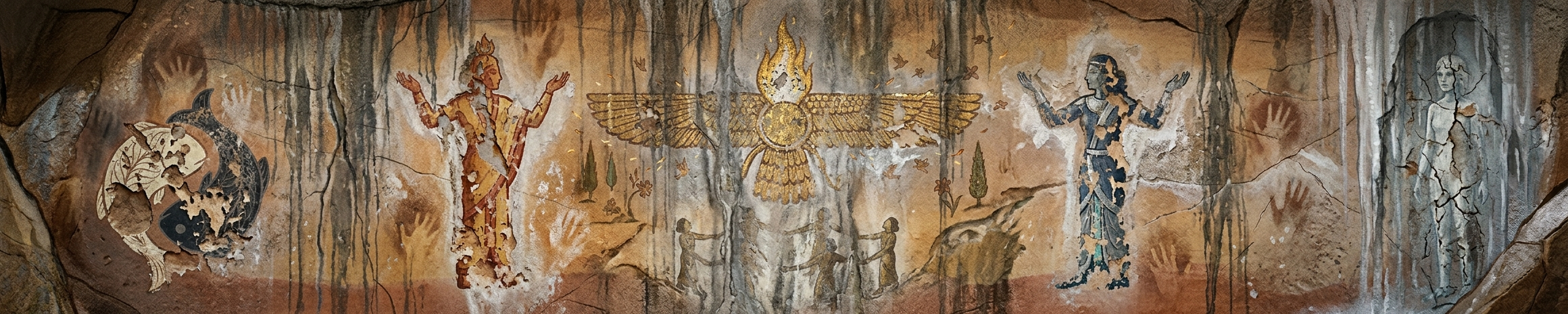
Two figures danced at the centre of the largest panel. A man robed with a sun, a woman with a crescent moon on her dress, arms raised, bodies curved toward each other. Between them burned a flame, but not like any flame I'd ever seen. This fire had wings, spread wide on either side, feathered and vast, as if the fire itself were a living creature about to take flight. Around them a circle of people danced, faces upturned, hands linked. They didn't look ritualistic. They looked happy---free in a way I'd never seen in Hawraman. In the highest corner of the vault, barely visible in the dimmer light, a great bird with folded wings. Its colours were strange --- dimming from the edges inward, as if the paint were remembering how to forget.
Other images crowded the walls, dense and layered --- more than I could take in. But one pulled me closer: two fish circling each other in an endless loop, one light, one dark, their bodies curved like the Boteh in my pocket.
Below the dancers, set into the wall where the painted figures' feet met the stone floor, a small dark stone no larger than my thumb. It caught none of the cave's glow. It sat there like a closed eye.
I reached out and pressed my palm against the painted fish. The stone was warm under my fingertips. The glow from the surrounding stones shifted, just briefly, and the fish seemed to move, swimming in slow circles, the light one chasing the dark, neither catching the other.
I pulled my hand back. The light playing tricks, probably. It had to be.
But the dancers at the centre kept pulling my gaze. And off to the side, almost hidden behind a curtain of pale dripped stone, a third figure. Same robes, same posture. But this one was turning away. Walking into darkness. Alone.
I stared at it for a long time. My throat felt tight, and I didn't know why. The figure looked like Hawraman felt --- turned away from the dance, walking into the dark. I could not tell from the painting whether the turning was a tragedy or a choice.
In our world, open flame was forbidden. Everyone had been told so many times, fire draws the storm divs, that the saying and the believing had become the same thing. Even a cooking flame had to be carefully contained, barely a glow under ash, watched and smothered before it could grow. And here were murals showing massive fires, people dancing around them in celebration, a flame with wings like it was the most precious thing they had.
I wanted to stay. To trace every figure, make sense of the story these walls were whispering. But Yameh's face kept flickering behind my eyes, pale and flushed, and I couldn't sit in a warm cave being fascinated while my sister suffocated in the cold.
I turned to leave.
That's when I saw the creature.
Warm Fur and Amber Eyes
It was sitting on a ledge near the passage entrance, watching me.
My first thought was cat. Something about the stillness, the tucked paws, the amber eyes weighing me up.
My second thought was that this was definitely not a cat.
The body was a lion's, compact and muscular, covered in golden fur that caught the cave light and held it. But the head was an eagle's, sharp-beaked and feathered, with pointed ears tipped with fur that turned toward me, alert to every sound. Folded against its sides were a pair of wings, small and delicate, layered in feathers of bronze and amber. They were too small for flight, more like the carved wings on a temple charm.
It was about the size of a small lamb. Smaller, even.
And it was glowing. Faintly. A soft golden pulse under its fur, warm and steady. When I held my hand out, palm open, I could feel the heat coming off it.
"Hey," I said.
One feathered eyebrow went up. The expression was so flatly, completely unimpressed that I almost laughed despite everything.
"Right. Sorry." I crouched down slowly, keeping my movements small. "I'm Yima. I'm---look, I'm a shepherd who lost a sheep and found a warm cave full of paintings of people dancing around fire. Today is already the strangest day of my life. You being here is barely the third strangest thing in it."
The creature tilted its head. Those amber eyes had a sharpness to them, a knowing that didn't belong on anything that small. It watched me the way Grandma watched me when I was lying about having eaten.
It made a small sound, somewhere between a purr and a chirp, then stretched, extending its tiny wings and arching its back so much like a cat that I almost reached out to scratch behind its ears.
"I have to go," I told it. "My sister's sick. Really sick."
It blinked at me once, hopped down from the ledge, landed without a sound on the cave floor, and padded to my feet. It looked up.
"I didn't invite you."
The creature lifted one feathered eyebrow again, as if it already knew I was being foolish.
We squeezed back through the crack in the mountainside. The crooked-horn sheep was still there, still chewing her stolen moss, utterly unbothered by the golden eagle-lion-thing that had just emerged from the mountain behind me.
The cold hit like a wall. The creature pressed closer to my leg. It hopped onto my boot. Before I could step back, it climbed my leg in three quick bounds and burrowed into the fold of my sheepskin wrap, settling against my ribs like it had measured the space. It fit perfectly, warm and compact, purring, and I was too cold and too tired and too scared about Yameh to question it.
I gathered the sheep with my free hand, nudging the crooked-horn troublemaker back toward the path with my knee, and started the long walk down.
What the Night Brought
The settlement was quiet when I returned. Sick-quiet, with everyone behind closed doors, coughing or praying or lying very still and trying to breathe.
A girl my age was stacking bundles of dried scrub-wood outside the common storehouse, working at a steady pace that almost felt offensive in the middle of a crisis. Each bundle the same size, the same tightness. She could order her way through the end of the world and come out with everything counted and stacked. Mitra, the drum-player's daughter. She didn't look up as I passed.
"Hustana needs more wild thyme," she said. No greeting, no idle words. "I left some at your door. And dried esfand."
"Thanks," I managed.
She nodded once and went back to her stacking. The creature shifted against my chest, and Mitra's eyes flicked to the movement, quick, observant. She didn't ask. Didn't stare. Just kept stacking.
I liked that about her, though I couldn't have told you why.
Inside our hut, nothing had changed and everything had gotten worse. Yameh's breathing had gone from rattling to something quieter, and the quiet was worse. Grandma sat where I'd left her, still holding my sister's hand, still murmuring fragments of whatever old prayer she'd been stitching together all day, her voice so low it was more vibration than sound.
Father lay on his own bed, his bandages spotted dark with seeping blood, caught in that grey space between sleep and something deeper. The gash on his forehead had been bound closed, but the skin around it was angry and raw.
I knelt beside Yameh and pulled the cloth from the water bucket. Cold again. I wrung it out and pressed it to her forehead anyway. Her skin was so hot the cloth steamed against it, the damp going to mist in a breath.
"I found something," I whispered. We'd been talking to each other since before we had words, even when she couldn't hear me. "Up in the mountain. A warm cave, with paintings of people dancing around fire. Real fire, big and open, with wings spread out from it. And this---"
The creature wriggled free from my wrap and hopped down onto Yameh's bed. Grandma's eyes flew open. She stared at the golden creature as it padded across the sheepskin, sniffed Yameh's hand, and curled against her side with a soft, insistent purr. Its glow brightened, just a little, and Yameh's breathing seemed to ease. The rattle softened. Her frown loosened in her sleep.
Or maybe I was imagining it. I'd been imagining a lot of things today.
"Chamrosh," Grandma breathed. The word came out strange, rusty, like she'd known it her whole life and never said it out loud. Her weathered hand trembled as she reached toward the creature, stopping just short of its golden fur.
"You know what it is?"
"I know the stories." Her voice was barely a whisper. "The seed-bird. The one the old songs say nests where the world is warmest." She shook her head, eyes bright. "I never thought to see one. Where did you find this creature, child?"
"A cave. Up past the stone marker, in the mountain." I looked at Grandma. "There are stones that glow. Warm water. Paintings of people dancing around fire like it was something to celebrate, not fear."
She pressed her fingers to her lips. For a long moment she said nothing, eyes fixed on the chamrosh curled against Yameh's fevered body. Then she turned back to my sister and resumed her murmuring, the same fragments of prayer, but with something new in her voice. Something harder, almost angry, like she was daring the words to work this time.
I sat back on my heels. Father hadn't moved. His bandages needed changing again.
The cave had answers. I was sure of it, though I couldn't have said why. But Yameh needed me here tonight. Cold cloths, bitter tea, my useless hands. Tomorrow. I'd go back tomorrow, if she lasted that long.